Matching Embroidery Thread Colours to Your Brand Colours
Custom Uniforms team · · 5 min read
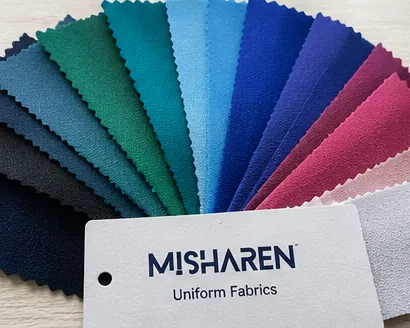
Embroidery thread comes in a fixed range of shades, so your brand colours are matched to the nearest available thread rather than mixed exactly like ink. To get a close match, send colour codes or a physical reference, tell us the garment colour, and check the stitched sample photo in good light before the full order. On dark garments, you may also need a slightly different colour scheme from the one you use on white.
Why thread is not the same as ink
A printer mixes ink to a formula. Embroidery uses ready-dyed thread, and each colour in your logo is a separate spool. The person digitising your logo chooses, for each part of the design, the thread shade that comes closest to your colour.
Thread also looks different from print because of how it reflects light. Stitches have a slight sheen and a direction, so the same thread can look a shade lighter or darker depending on the angle and the light. A flat colour on screen becomes a textured colour on fabric. This is normal, and it is why approving a stitched sample matters more than comparing hex codes.
What to send for colour matching
The more precise your reference, the closer the match. In order of usefulness:
- Your brand guide, if you have one, with Pantone, CMYK or hex values for each colour.
- A physical item in the right colour: an existing embroidered uniform, a printed brochure or a signboard photo taken in daylight.
- The logo file itself, ideally a vector file where the colours are set accurately.
Screens vary, so a colour that looks right on your phone may look different on ours. If the exact shade matters, say so, and send a physical reference or a code rather than relying on a screenshot.
If you already have embroidered uniforms from another supplier and want new ones to match, tell us. A photo of the old embroidery beside a white sheet of paper, in daylight, helps us see the actual shade.
Light garments and dark garments
The garment colour changes how the logo reads. A logo designed on a white background may look quite different on navy, black or maroon.
On white and light garments, most logos work as designed. Pale colours in the logo, such as light yellow or light grey, may need a darker outline so they do not fade into the fabric.
On dark garments, dark parts of the logo can disappear. A navy logo on a navy polo is the classic example. Common fixes:
- Use a white, silver-grey or gold version of the dark parts.
- Add a light outline around the logo or lettering.
- Use a reversed version of the logo, if your brand guide has one.
On mid-tone garments, such as light blue, grey or bottle green, check contrast carefully. Some brand colours sit very close to these shades.
If you embroider the same logo on several garment colours, for example white shirts for staff and navy polos for events, you may need two approved colour schemes. Each is set up once and recorded, so you know which version goes on which garment.
How many colours to use
Each thread colour adds work and more chance of small gaps or misalignment at small sizes. For a chest logo, a modest number of solid colours usually looks cleaner than many shades. Gradients and shading in a logo are usually converted into flat bands of colour, or simplified to one shade.
Fewer colours also make it easier to keep the logo consistent across reorders. Our guide on how to prepare your logo for embroidery covers simplifying artwork for thread.
Approving with a sample photo
Before stitching the full quantity, we stitch a sample and send a photo on WhatsApp. Check it properly:
- Look at the photo in good light on a reasonable screen, and zoom in.
- Compare it with your reference, not just your memory of the logo.
- Check every colour separately. The main colour may be right while a small accent is off.
- Check contrast against the garment. Is every part visible from a normal distance?
- Check spelling and size at the same time, if there is text.
Remember that a phone photo can shift colours slightly. If something looks off, describe it in words, such as “the red should be deeper” or “the blue is too bright”, and ask whether a different thread shade is available. If exact colour is critical, say so before the sample is stitched, and ask whether you can see the sample piece itself before approving.
Once you approve, the thread colours are recorded with your logo, so the next order uses the same shades.
Keeping colours consistent over time
Brand colour problems often appear on the second or third order, not the first. To avoid them:
- Keep a written note of the approved thread colours for each garment colour.
- Keep one approved embroidered piece as a reference.
- Use the same garment colour from the same supplier where possible, since fabric shades vary between suppliers and batches.
- If you change your logo or brand colours, say so when ordering, so a new version is set up and approved.
For uniforms reordered every year, our guide on keeping uniforms consistent across reorders covers fabric and style as well as embroidery.
Common mistakes
- Sending a low-resolution screenshot and expecting an exact colour.
- Approving a sample photo on a dim phone screen without zooming in.
- Using the same dark logo on dark garments without checking contrast.
- Not recording the approved colours, so the next order is matched again from scratch.
How we match thread colours
Embroidery is one of our main services, running now at our unit in Konni, Pathanamthitta, Kerala. We embroider logos, names and short text on uniforms, shirts, polo t-shirts, caps and bags, including garments you bring or courier to us. We digitise your logo once and keep it on record, along with the approved thread colours, size and position, and any one-time digitising charge is confirmed in the quote. We stitch a sample and send a photo on WhatsApp for approval before the full quantity. If you need the uniforms made too, see our medical uniforms and school uniforms pages.
To get your brand colours right in thread, read about our embroidery service, or send your logo, colour codes and garment colours on WhatsApp or through our quote form.