Scrubs vs Lab Coats: Which Does Your Team Need?
Custom Uniforms team · · 4 min read
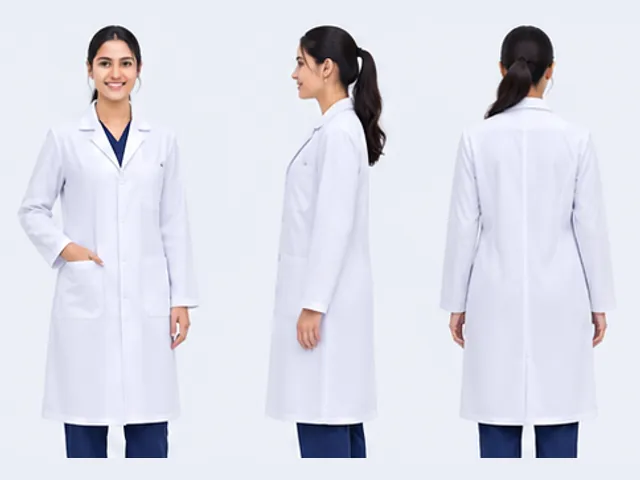
Scrubs are a full working outfit, a top and trouser worn in place of everyday clothes. A lab coat is an outer layer, worn over scrubs or regular clothing and taken off when it is not needed. Most hospitals and clinics need both, for different people or for different moments in the same person’s day. The real question is not scrubs vs lab coats, but who wears which, and when.
What scrubs are for
Scrubs are designed to be worn all day and washed often. They are simple, loose-fitting and easy to move in, with no buttons or loose parts to catch on equipment. Because they replace personal clothing, everyone in a department can look the same regardless of what they wore to work.
Scrubs suit roles where people are hands-on with patients for long periods: nurses, OT teams, ICU and casualty staff, physiotherapists, dental assistants and many technicians. They are also the natural base for a colour-coded uniform scheme, since the whole outfit carries the colour.
What lab coats are for
A lab coat is a long, open-fronted coat, usually white, with pockets and a collar. It is worn over other clothes and taken off easily. In clinical settings it signals a role, most often a doctor, consultant or pharmacist, and gives a tidy, professional look during rounds and consultations.
In laboratories, the coat is the main uniform garment. It keeps everyday clothes covered at the bench and gives staff somewhere to keep pens, markers and small items. Many labs ask staff to remove coats before leaving the lab area, so the coat stays where the work is.
Scrubs vs lab coats side by side
| Scrubs | Lab coat | |
|---|---|---|
| What it is | Top and trouser set | Long outer coat |
| Worn | All shift, instead of personal clothes | Over scrubs or regular clothes, on and off |
| Typical wearers | Nurses, OT and ICU staff, therapists, dental teams | Doctors, consultants, pharmacists, lab staff |
| Colour | Often coded by role or department | Usually white, sometimes coloured for specific roles |
| Branding | Chest logo, name and title | Chest logo, name and title, sometimes department on the sleeve |
| Washing | Very frequent | Frequent, but usually fewer sets per person |
When to combine them
Many doctors wear scrubs for procedures and put a lab coat on top for rounds or outpatient clinics. That combination works well if the scrubs and coat are planned together: the coat should be long enough to cover the scrub top and roomy enough at the shoulders to sit over it comfortably.
In diagnostic labs, some teams wear scrubs as the base layer and a coat over them at the bench. This keeps personal clothing out of the lab entirely. Our guide to diagnostic lab uniforms goes into lab roles in more detail.
Questions to help you decide
Work through these for each role in your organisation:
- Does this person spend most of the shift in physical contact with patients? If so, scrubs are usually the base.
- Do they need to look distinct to patients, for example as the consulting doctor? A lab coat over scrubs or formal clothing does this clearly.
- Do they move between clinical and non-clinical areas? A coat that comes off at the door is practical.
- Will the garment be laundered by the hospital or at home? Lab coats are bulkier, so plan laundry capacity.
- What does your organisation’s infection control or safety policy say about outer garments? Follow that first.
Fabric and fit differences
Scrub fabric needs to breathe, move and survive constant washing. Our guide on how to choose scrub fabric covers the options.
Lab coat fabric is often slightly heavier, so the coat hangs well and looks crisp. White coats show marks quickly, so think about how they will be washed and how many each person needs. Check the length (hip, mid-thigh or knee), the sleeve style, the number of pockets and whether the coat closes with buttons or snaps.
Fit matters differently too. A lab coat that is too tight across the back will strain at the buttons when worn over scrubs. When you collect sizes, ask staff to try the coat on over whatever they will wear underneath.
Planning a mixed order
If you are ordering scrubs and lab coats together, keep the branding consistent. Use the same logo artwork, thread colours and name format on both, so a doctor’s coat and a nurse’s scrubs clearly belong to the same organisation. Approve a sample of each garment, because a logo that looks right on a scrub top may need resizing on a coat lapel or chest pocket.
How we handle scrubs and lab coats
We make both scrubs and lab coats to order at our unit in Konni, Pathanamthitta, Kerala, in custom colours, fabrics and sizes, with logo and name embroidery. A sample of each garment can be made before bulk production, with any sample charge stated in the quote. We keep records of fabric, colour, style and sizes, so you can reorder either garment later and have it match.
For details on both, see our medical uniforms page, or ask for a quote for your team.