Lab Technician Uniforms: A Guide for Diagnostic Labs
Custom Uniforms team · · 4 min read
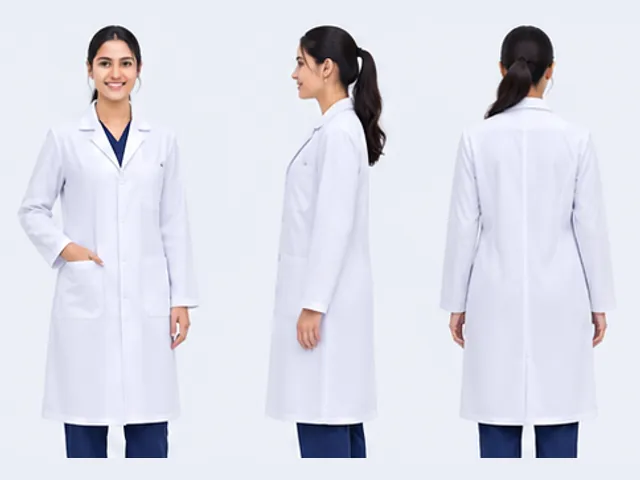
Lab technician uniforms usually combine a lab coat for bench work with scrubs or a simple base uniform underneath, while collection and front desk staff wear something that looks professional to patients. The right plan depends on what each role does, where it is done and how many branches you run. Getting it right gives patients confidence and keeps the whole lab looking like one organisation.
Lab technician uniforms and other lab roles
A typical diagnostic laboratory or collection network has more roles than people expect, and each has slightly different uniform needs.
| Role | Where they work | Common uniform |
|---|---|---|
| Lab technicians | Bench, analysers, processing areas | Lab coat over scrubs or regular clothes |
| Pathologists and microbiologists | Lab and reporting rooms | Lab coat, sometimes with scrubs |
| Phlebotomists | Collection rooms, patient-facing | Scrubs or tunic, often with a short coat |
| Home sample collection staff | Patients’ homes, on the road | Branded polo, tunic or scrub top that travels well |
| Front desk and billing | Reception | Smart shirt, tunic or polo in brand colours |
| Support and housekeeping | Across the building | Durable support uniform |
Start by listing your own roles and how many people are in each. That list becomes the basis of your order.
Lab coats for bench work
The lab coat is the core garment for most lab technicians. When choosing one, think about:
- Length. Knee-length coats cover more of the clothing underneath; hip-length coats are lighter and less likely to catch on equipment.
- Closures. Buttons or snaps; many labs prefer snaps because a coat can be removed quickly.
- Cuffs. Plain or knitted cuffs that sit close to the wrist are easier to keep clear of the bench than wide, open sleeves.
- Pockets. Enough for pens, markers and small items, without so many that the coat becomes a storage cupboard.
- Colour. White is traditional and shows that the coat is clean; some labs use a coloured coat for a particular team.
Lab coats are often treated as protective clothing in a laboratory. Your lab’s biosafety or safety policy should decide what kind of coat is used for which tasks. If a coat needs a specific fabric or finish for safety reasons, ask any supplier for the fabric specification in writing and check it against your policy.
Scrubs and base uniforms
Many labs now ask technicians to wear scrubs under their coats, so personal clothing stays out of the work area and the team looks uniform even when coats are off. Scrubs also suit phlebotomists, who spend the day with patients and need easy movement. Our guide to scrubs vs lab coats explains how the two garments work together.
Home collection and patient-facing teams
Home sample collection staff are often the only person from your lab that a patient ever meets. Their uniform carries your brand into homes and offices, and it needs to work on a two-wheeler in heat and rain as well as in a living room.
Practical choices include a breathable polo or tunic with a clear chest logo, a matching trouser, and a lightweight outer layer for the monsoon. A name and ID on the uniform helps patients feel comfortable letting a collector into their home.
Fabric and colour
Lab coats are washed often, and white shows everything, so a durable poly-cotton fabric that holds its colour and shape is a common choice. For scrubs and collection uniforms, a breathable fabric matters in a hot climate.
For colours, many labs pick one brand colour for scrubs and patient-facing uniforms and keep coats white. That gives a clean, consistent look in photographs, at collection centres and on home visits.
Consistency across branches
Diagnostic networks often grow branch by branch, and uniforms drift as each new centre orders separately. To keep things consistent:
- Write a one-page uniform specification: garment styles, colours, fabric, logo size and position, and name format.
- Approve a sample of each garment and keep it at head office as the reference.
- Place orders centrally where possible, with a size breakdown for each branch.
- Make sure your supplier keeps the specification on record for reorders.
Our guide to keeping uniforms consistent across reorders goes into this in more detail.
How we help diagnostic labs
We make lab coats, scrubs and staff uniforms to order at our unit in Konni, Pathanamthitta, Kerala, in custom colours, fabrics and sizes, with logo and name embroidery. A sample can be made before bulk production, with any sample charge stated in the quote. We keep records of fabric, colour, style and size breakdown for each order, so that new branches and new staff receive uniforms that match. We deliver across India.
To plan uniforms for your lab or collection network, see our medical uniforms page or request a quote.