Kindergarten and Play School Uniforms: LKG and UKG Guide
Custom Uniforms team · · 5 min read
Kindergarten and play school uniforms should be soft, easy to put on and take off, simple to wash every day, and cut with room for a child who will grow noticeably during the year. For LKG and UKG, comfort and practicality matter more than formality: elastic waists, wide neck openings, few fiddly fastenings and colours that forgive the odd stain. This guide covers what to decide when planning uniforms for the youngest children in your school.
How little children use a uniform
A three or four year old does not sit still in a uniform. They sit on the floor, paint, eat with their hands, play in sand and sometimes have toilet accidents. Teachers and ayahs help them dress and use the toilet several times a day. A good pre-primary uniform makes all of this easier:
- A child can pull trousers or shorts up and down without help, or with very little help.
- A teacher can change or adjust the uniform quickly.
- The fabric is soft against the skin and does not scratch at the neck or waist.
- It survives daily washing by parents who have little time.
If the uniform fails at any of these, parents and teachers feel it within the first week.
Garments that work for LKG and UKG
Most pre-primary sections use a simplified version of the main school uniform, so children look part of the school without the stiffness of a senior uniform.
For boys and girls: a half-sleeve shirt or a soft t-shirt style top, with shorts or a pinafore. Some schools use the same shorts for all children in the youngest classes.
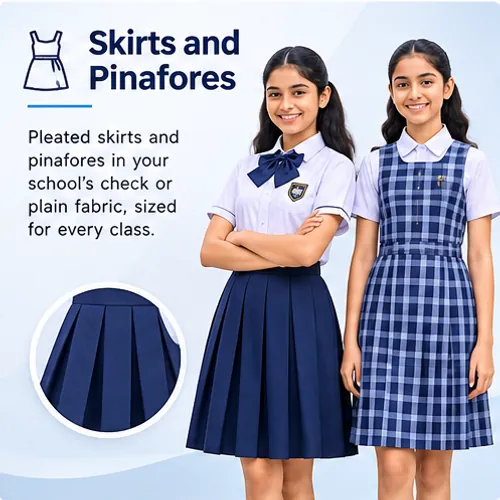
Pinafores: a pinafore over a shirt is a popular choice because it is easy to slip on, and it covers well when children sit on the floor. Look for wide shoulder straps that stay in place and a simple fastening.
Shorts and trousers: an elastic waist is far easier for a small child than a button and zip. A fully elasticated waist or an elastic back with a flat front both work.
PT and activity days: a t-shirt with shorts or soft track pants is enough. Many play schools use this as the everyday uniform on activity days.
Our guide to pinafores, skirts and salwar sets explains how girls’ uniforms usually progress from pre-primary to senior classes.
Fastenings: keep them few and easy
Buttons are the most common source of trouble for small children. When planning the design:
- Keep shirt buttons to the front only, and not too small.
- Avoid back fastenings on pinafores that a child cannot reach.
- Prefer elastic waists to hooks, buttons and zips on bottoms.
- Avoid ties, belts and loose cords for the youngest classes. They get lost, pulled and tangled.
Discuss the fastening style with your uniform maker at the quote stage, and check it on the sample by asking a child to try it.
Fabric and washing
Pre-primary uniforms are washed more often than any other uniform in the school. Choose a fabric that is soft, breathes in Kerala’s heat, and holds its colour after repeated washing. Very pale colours show every mark, so many schools use a mid-tone for shorts, pinafores and skirts, with a white or light shirt.
During the monsoon, uniforms dry slowly at home. A fabric that dries reasonably quickly helps parents who have only two sets. Our school uniform fabric guide for the monsoon covers this in more detail.
Ask parents to label every garment with the child’s name. Small children cannot recognise their own uniform among thirty identical ones.
Sizing for children who grow fast
Children in LKG and UKG can grow a lot in one school year. A few practical rules:
- Size with a small margin, not the tightest fit, so the uniform still fits towards the end of the year.
- Do not go far oversized. Sleeves over the hands and shorts that slip down are a safety and comfort problem.
- Ask for a generous hem on pinafores and skirts that can be let down later.
- Elastic waists cope better with growth than fixed waists.
Size trials work well at this age because parents often guess sizes from age alone, and children of the same age vary a lot. Our guide on collecting student uniform sizes explains how to run a trial class by class, and the school uniform size chart guide explains how the smallest sizes fit into the full LKG to Class 12 range.
Badge and identification
A small embroidered school logo on the pocket or chest is usually enough for pre-primary. Keep it soft on the inside so it does not scratch. Some schools add the child’s name for the youngest classes, which helps teachers in the first weeks. Our school badge embroidery guide covers sizes and placement.
A planning checklist for pre-primary uniforms
- Simple garment list: shirt or top, shorts or pinafore, PT set.
- Elastic waists and few fastenings.
- Soft fabric that washes and dries well.
- Mid-tone colours for bottoms and pinafores.
- Sizes collected with a try-on, with a small growth margin.
- A sample tested on a child before bulk production.
- Name labels requested from parents.
Play schools and standalone kindergartens
A standalone play school or kindergarten often has small numbers across a few age groups. That is fine for ordering: mixed sizes can be combined in one order, and the same design can run across all your groups. Keep the design and fabric on record so the next intake matches the current one.
Get uniforms for your youngest students
We make school uniforms to order at our unit in Konni, Pathanamthitta, Kerala, including shirts, shorts with elastic waists, pinafores and PT uniforms for LKG and UKG, matched to the rest of your school uniform, with logo embroidery on pocket or sleeve. The minimum order is 30 sets with mixed sizes allowed, so a kindergarten or play school can order across all its age groups together. We make one paid sample set first, and its cost is credited against your bulk order.
Visit our school uniforms page, then send your requirement on WhatsApp or through the quote form.