Care Labels for Clothing: A Guide for Uniform Brand Owners
Custom Uniforms team · · 4 min read
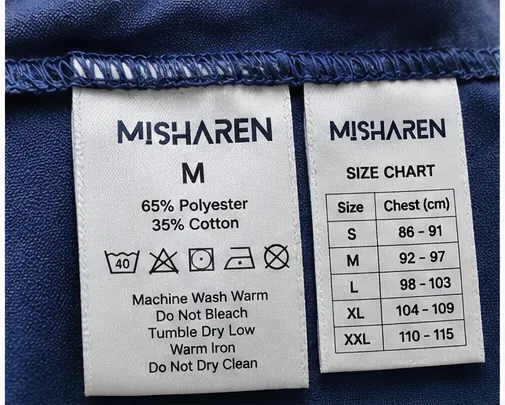
Care labels for clothing tell the wearer what the garment is made of and how to wash, dry and iron it without damaging it. For a uniform or scrubs brand, the care label is also part of how customers judge quality, because a garment that shrinks or fades after following the label reflects on the brand. The content of the label is the brand owner’s responsibility, so it pays to get it right before production.
What a care label usually contains
Most care labels carry some combination of the following:
- Fibre content: for example, the blend of polyester, cotton, viscose and elastane, usually by percentage of the fabric’s composition as given by the fabric supplier.
- Washing instructions: machine or hand wash, and the maximum temperature.
- Bleaching: whether bleach can be used, and which type.
- Drying: tumble dry or not, and at what heat; line or flat drying.
- Ironing: the maximum iron temperature, or no ironing.
- Professional cleaning: dry clean or not.
- Other details: country of manufacture, brand name, size, a style or batch code, and the name or address of the business responsible, depending on the market.
Exactly which of these are required, and in what form, depends on where the garments are sold. Labelling rules differ between countries and change from time to time. Confirm the requirements for your market with the relevant authority or a specialist adviser before you approve label artwork.
Words, symbols or both
Care instructions can be written in words, shown as symbols, or both. Symbols save space and cross language barriers, but not every customer reads them confidently. Many brands use symbols with a short line of text, such as “Wash inside out with similar colours”.
Different markets use different symbol systems, and the symbols are not always identical. If you sell in more than one country, check that your symbols will be understood in each, and keep them consistent across your range.
Getting the instructions right for uniforms
Uniforms are washed far more often than most clothing, sometimes after every shift. That makes the care instructions especially important. To set them:
- Start from the fabric specification. Ask your fabric supplier or manufacturer for the recommended care for the exact fabric.
- Consider how the garment is really washed. Scrubs may go through hot washes at home or in a hospital laundry. School uniforms are washed by parents, often with everything else.
- Test the sample. Wash and dry the pre-production sample several times following your draft label. Check shrinkage, colour, embroidery and how it looks after ironing.
- Account for trims. Embroidery thread, buttons, zips and elastic all have their own limits. The label should suit the most delicate part.
- Be conservative. If the fabric might shrink in a hot tumble dryer, say so. A label that is cautious protects both the wearer and the brand.
Our guide on how to wash scrubs and make them last gives the wearer’s side of the same question.
Placement and comfort
Where the label sits affects comfort. Common positions are:
| Garment | Typical care label position |
|---|---|
| Scrub top or tunic | Left side seam, near the hem |
| Scrub trousers | Inside back waistband or side seam |
| Lab coat | Inside side seam or back neck with the brand label |
| School shirt | Side seam near the hem |
| Skirts and pinafores | Inside waistband or side seam |
Side seams are often preferred for scrubs, because a stiff label at the back neck can rub during a long shift. Whatever position you choose, keep it the same across your range so wearers know where to look.
Label material
Care labels have to survive every wash the garment does, so the material matters. Printed satin and nylon tapes are common because they are soft and keep the print readable. Woven labels are durable but can be stiffer. Our comparison of woven vs printed clothing labels goes into the choice in more detail.
A checklist before you send label artwork
- Fibre content matches the fabric specification for this order.
- Wash temperature and drying instructions were tested on the sample.
- Symbols are correct for each market you sell in.
- Spelling and translations are checked by a native reader.
- Size, style code and brand name are correct.
- Your business details are included if your market expects them.
- The label is soft enough for the position you have chosen.
How we handle care labels
Through our private label service, we sew the buyer’s own brand, size and care labels into garments made to order at our unit in Konni, Pathanamthitta, Kerala. You supply or approve the label content, since the care-label responsibility sits with the brand owner, and we can tell you the fabric we are using so your fibre content is accurate. The labels are checked on the sample before bulk production starts.
If you sell in the UK or other international markets, see our page for UK buyers and confirm the local requirements with your adviser before production.