Branded Hospital Uniforms for Multi-Site Hospital Groups
Custom Uniforms team · · 4 min read
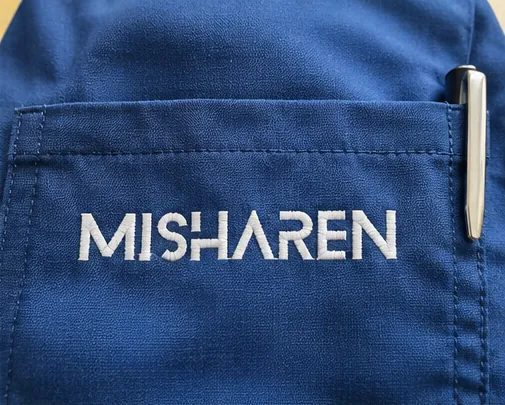
Branded hospital uniforms carry the group’s name and identity on every garment, from the logo on the chest to the label inside the collar. For a hospital group with several sites, the challenge is not designing one good uniform but making sure a nurse in one town looks the same as a nurse in another, year after year. That comes down to a written brand standard, a clear role system and a manufacturer who works to both.
What “own-brand” means for a hospital group
Many hospitals already put a logo on their scrubs. An own-brand uniform goes further. It treats the uniform as part of the group’s identity, controlled centrally, and usually includes:
- The group logo embroidered in a fixed size, position and thread colour.
- A defined colour for each role or department, used at every site.
- The group’s own brand label inside the garment, instead of a supplier’s label.
- Size and care labels in the group’s format.
- One specification for fabric and fit, so a medium is a medium at every hospital.
The result is that patients and visitors recognise staff from the same group wherever they are, and staff moving between sites do not need new uniforms.
Start with a uniform brand standard
Before talking to any manufacturer, write down the standard. It does not need to be long, but it does need to be specific. A good brand standard for branded hospital uniforms covers:
- Logo artwork. A clean vector file, plus a simplified version if the full logo has fine text that will not embroider clearly at small sizes.
- Thread colours. The exact colours for embroidery, matched to your brand colours and checked on a stitched sample, since thread rarely matches a screen perfectly.
- Placement. For example, “logo left chest, 8 cm wide, centred 18 cm below shoulder seam”. Our placement guide for logo embroidery on scrubs goes into the common positions.
- Role colours. Which colour each staff group wears.
- Garment styles. Scrub top neckline, pocket layout, trouser waistband, lab coat length.
- Fabric. The fabric type and weight, with a swatch kept on file.
- Labels. Brand, size and care label design and position.
Once approved, this document and a set of approved samples become the reference for every order.
Building a role colour system across sites
A colour system helps patients and colleagues tell roles apart at a glance. The key for a group is to fix it once and apply it everywhere. If one site uses navy for nurses and another uses navy for theatre staff, the system stops working the moment people move between them.
| Decide | Why it matters across sites |
|---|---|
| Colour per role | Staff and patients learn one system for the whole group |
| Number of colours | Fewer colours are easier to keep consistent and to reorder |
| Name or title embroidery | Helps patients identify staff at sites where faces are unfamiliar |
| Accent details | Piping or a contrast collar can mark seniority without adding a new base colour |
Our guide to scrub colours by department has ideas for setting up the colours themselves.
Ordering centrally, delivering to each site
Groups usually choose between ordering centrally for all sites or letting each site order against the shared standard. Central ordering gives tighter control over colour and quantities, since one larger order is made at the same time from the same fabric. Site ordering gives flexibility but needs stricter checks to keep everything matched.
A middle path works for many groups:
- Place the main rollout order centrally, with a size breakdown per site and per role.
- Ask the manufacturer to pack and mark cartons by site and department, so distribution is straightforward.
- Let sites raise smaller top-up orders for new joiners, always quoting the original order reference.
Rolling out the new uniform
A phased rollout reduces risk. Start with one site or one department, gather feedback on fit and comfort for a few weeks, then make small adjustments before the full order. Changes at this stage are far cheaper than after every site has received stock.
Collect sizes carefully for each site. A size trial with sample garments in each size gives much better results than asking staff to guess. Plan for spare sets per person and a small reserve for new staff.
Keeping the brand consistent over time
The first rollout is the easy part. The real test is the order eighteen months later, when a new site opens or staff numbers grow. Keep these on file:
- The approved samples, one per style and colour.
- The brand standard document, with any changes dated.
- Order references and size breakdowns for each past order.
When a reorder is placed, compare the first garments from the new batch against the stored sample before distributing them.
How we handle hospital group orders
We make scrub suits, lab coats, nurse uniforms, OT gowns, patient gowns and housekeeping and support-staff uniforms to order at our unit in Konni, Kerala. We embroider logos and names, and sew in the group’s own brand, size and care labels. A sample can be made in your fabric, colour, style and embroidery before bulk production, with any sample charge stated in the quote. We keep records of fabric, colour, style and size breakdown so that reorders for any site match the original.
See the full range of medical uniforms we make and how our private label service works, or contact us to plan your group’s uniform.