Private Label Uniforms for Retailers and Uniform Shops
Custom Uniforms team · · 4 min read
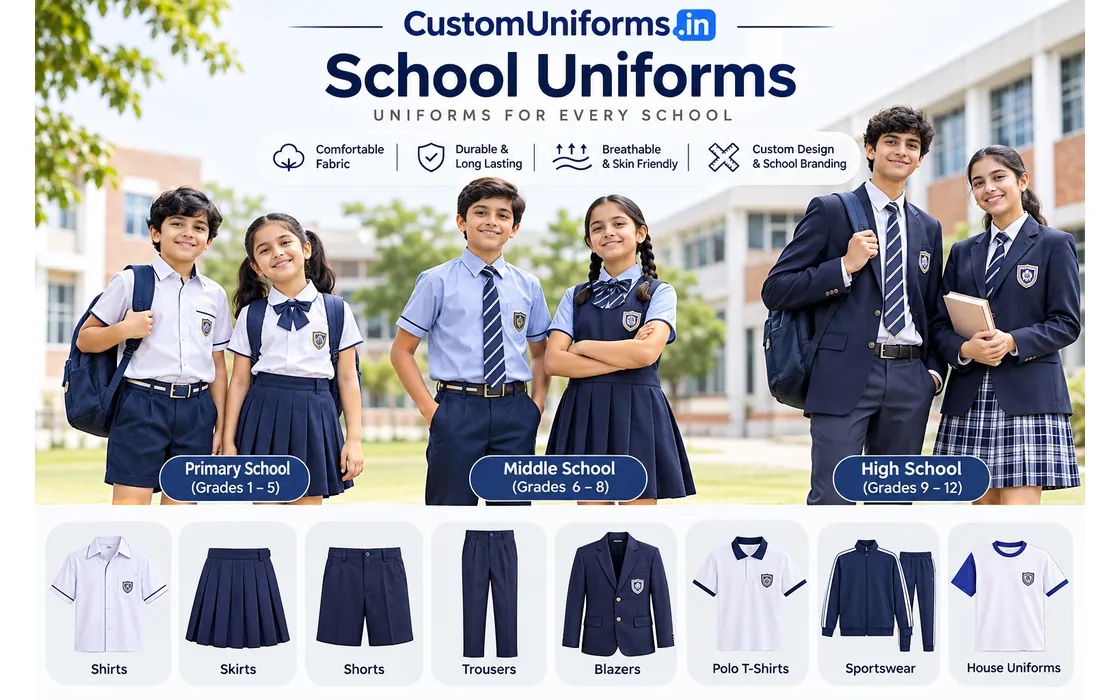
Private label uniforms for retailers are garments made by a manufacturer but sold under the shop’s own name, with the shop’s brand, size and care labels sewn in. For a uniform shop, it means every school shirt or scrub set that leaves the counter carries your name, not someone else’s. It also gives you more control over fabric, fit and supply than buying finished stock from a wholesaler.
Why private label uniforms make sense for retailers
Most uniform shops start by buying ready-made stock and reselling it. That works until a few problems keep repeating: a school’s shade of blue changes between batches, popular sizes run out in the middle of the season, or parents compare your price with a shop down the road selling the same unbranded garment.
An own label addresses these in a practical way:
- Your name builds repeat custom. Parents and staff who are happy with a shirt look for the same label next year.
- You set the specification. Fabric, colour, collar style and sizing follow your standard, so quality does not depend on what a wholesaler happens to have.
- Reorders match. When the fabric, colour and pattern are on record with your manufacturer, the next batch can be made to the same details.
- You can serve institutions directly. A school or clinic that wants one consistent supplier can deal with you, and you deal with the factory.
What a retailer’s private label range can include
Uniform shops usually work across two kinds of customer, and the range reflects that.
School uniforms. Shirts, trousers, shorts, skirts, pinafores, salwar sets, PT and sports uniforms, and house t-shirts, each made to a particular school’s colours and design. A shop serving several schools needs a separate specification for each one, even when the garments look similar.
Medical and workwear. Scrub suits, lab coats and nurse uniforms for local hospitals, clinics, labs and nursing colleges. These often sell steadily all year rather than in one seasonal rush, which helps smooth out cash flow for a shop that is busy only before the school year.
Start with the lines that already sell well for you. A focused first range is easier to manage than trying to brand everything at once.
Planning the range, school by school
The detail that matters most for a uniform shop is the specification sheet. Keep one for every school or institution you supply, with:
- Each garment style and its reference sample.
- Fabric type and colour reference, ideally with a swatch.
- Badge or logo artwork, embroidery size and position.
- The size range you stock, from the smallest to the largest.
- Your label set and where each label sits.
- Notes on any differences between classes, for example shorts for younger boys and trousers from a certain class upward.
A sheet like this protects you if staff change, and it is the first thing your manufacturer will ask for. Our guide to collecting student uniform sizes helps if a school asks you to handle sizing for the whole year group.
Stock and timing for school seasons
For school uniforms, timing decides whether a private label works. Kerala schools reopen in June, and most of the selling happens in the weeks around reopening. That means production needs to be planned months ahead, ideally with orders placed between December and March so there is time for samples, corrections and stitching.
A few habits help shops avoid shortfalls:
- Look at last year’s sales by school and by size, not only total numbers.
- Order core sizes in depth and edge sizes in smaller quantities.
- Plan a smaller top-up order for mid-year admissions and children who outgrow their uniforms.
- Keep a little fabric-matched stock of the slowest sizes so one late request does not mean a full production run.
Our post on mid-year school uniform reorders looks at the second half of the year in more detail.
Labels, presentation and pricing
Your label is the visible part of the brand, so it is worth getting right. A woven brand label at the neck or waist, a clear size label, and a care label with accurate fibre and washing information are the usual set. As the brand owner, the wording on the care label is your responsibility.
Think about pricing from the start. Your own label should let you stand behind quality rather than compete only on price. Work out what you need to earn on each garment after fabric, stitching, embroidery and labels, and talk to the manufacturer about which choices move the cost most.
Questions to settle with your manufacturer
Before your first order, agree on:
- The minimum quantity per school, style or colour, and whether different sizes can be combined.
- Whether a sample is made for each school’s design, and any sample charge.
- How labels are supplied and where each one is sewn.
- How records are kept so the next season’s order matches.
- Lead time for the main order and for small top-ups.
How we work with uniform shops
We make uniforms to order at our unit in Konni, Pathanamthitta, Kerala, and sew in the retailer’s own brand, size and care labels. Small bulk orders are welcome, and the minimum order and lead time are confirmed in each quote. A sample can be made before bulk production, with any sample charge stated in the quote. We keep records of fabric, colour, style and size breakdown for each order, so next season’s stock matches this season’s. We deliver across India.
To talk through a range for your shop, see our private label service and the school uniforms we make, or ask for a quote.