Patient Gowns: What Hospitals Should Look For When Buying
Custom Uniforms team · · 5 min read
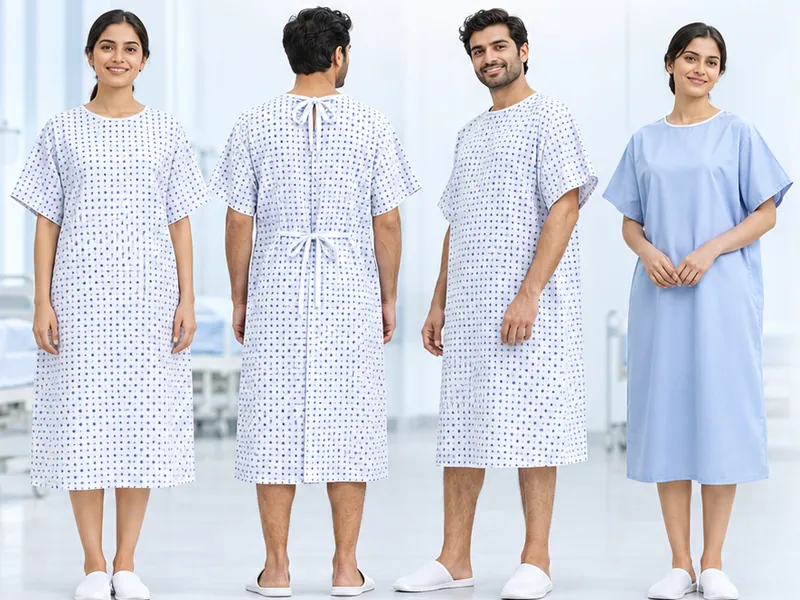
Good patient gowns are easy for staff to put on and take off a patient, give the patient proper coverage and dignity, and keep their shape through constant washing. The details that decide this are the opening, the fastenings, the cut and the fabric. This guide explains what to check on each before you place a bulk order.
Start with how the gown is used
A gown on a general ward is used very differently from one in day surgery, maternity or an ICU. Before choosing a design, ask the nursing team a few questions:
- Are patients mostly mobile, or in bed for long periods?
- How often do staff need access to the chest, back, arms or abdomen for examinations, ECGs, drips or dressings?
- Are gowns used for a few hours (day care, diagnostics) or for days at a time?
- Who changes the gown: the patient alone, or a nurse or attendant?
The answers usually point to one or two designs rather than one gown for everything. Many hospitals keep a standard ward gown and a separate design for maternity or procedures.
Openings and coverage
The opening is the most important design choice.
- Back opening. The traditional design, easy for staff to put on a patient in bed. The weak point is coverage when the patient walks. A generous overlap at the back, so one panel crosses well over the other, helps a great deal.
- Side or wrap opening. The gown wraps across the body and fastens at the side. It gives better coverage for mobile patients and is often preferred by patients themselves.
- Front opening. Useful for maternity and for patients who dress themselves. It allows chest access without removing the gown.
- Shoulder and sleeve openings. Fastenings along the shoulder or down the sleeve let staff change a gown without disconnecting a drip line, and make it easier to reach the upper arm.
Ask for a sample and have someone of average and larger build wear it, sitting, standing and walking. Coverage problems show up immediately.
Ties, snaps or press buttons
| Fastening | Strengths | Things to watch |
|---|---|---|
| Fabric ties | Simple, no metal or plastic parts, adjustable to body size | Can tangle in the wash, harder for patients to tie at the back, may tear off if poorly stitched |
| Snaps or press buttons | Quick for staff, neat, hold securely | Must be good quality to survive hot washing, need to be positioned for different body sizes |
| Velcro-type tape | Fast to open | Collects lint, can snag other linen in the laundry, wears out with repeated use |
Whatever you choose, look closely at how the fastening is attached. Ties should be stitched into the seam with a box or bar tack, not only along the edge. Snaps should sit on a reinforced, double layer of fabric.
Sizing and fit
“One size fits all” gowns are convenient for stock control but rarely fit all. A gown that is too narrow gapes at the back; one that is too long becomes a trip hazard. Most hospitals do better with a standard size, a larger size for bigger patients, and a separate paediatric size if they treat children.
Sleeve style matters too. Short or cap sleeves leave the arms free for blood pressure cuffs and drips. Kimono-style sleeves are roomier and easier to put on a patient with limited movement.
Fabric and wash durability
Patient gowns are washed far more often than staff uniforms, usually in hospital laundries. Common choices are pure cotton, which is soft and cool against the skin, and poly-cotton blends, which generally hold their shape and colour longer through frequent washing and dry faster. Fabric weight matters as well: too thin and the gown becomes see-through after repeated washes, too heavy and it is hot on the ward.
Hospitals sometimes ask about special finishes. Gowns described as having barrier or protective properties are a different category of product, and any claim of that kind should come with a clear specification from the supplier. For ordinary ward gowns, ask any supplier for the fabric composition, weight and recommended washing temperature, then confirm these suit your laundry process.
Colour, print and identification
Colour is a quiet but useful tool. A single colour for ward gowns helps the laundry sort them from staff uniforms and bed linen. Some hospitals use a different colour or a small print for paediatric or maternity gowns. Printing or embroidering the hospital name near the hem reduces losses, because gowns that leave with discharged patients are easier to recognise and return.
Avoid very pale colours for gowns that will be used for long stays, since they show staining quickly, and avoid strong dark colours that make it harder for staff to notice spills or bleeding.
Planning stock levels
Think in terms of circulation, not just beds. For each bed you need gowns on patients, gowns in the laundry, and gowns on the shelf ready to use. Add a margin for losses, damaged gowns and busy periods. Many hospitals review gown stock alongside a wider hospital uniform refresh, since the same laundry and storage teams handle both.
How we make patient gowns
We make patient gowns and OT gowns to order for hospitals in India, at our unit in Konni, Pathanamthitta, Kerala. You choose the opening, fastenings, fabric, colour and sizes, and we can add your hospital name or logo. We can make a sample first so your nursing team can test it on the ward, with any sample charge stated in the quote; our post on why sample approval matters explains what to check. Minimum order and lead time are confirmed in each quote, and we keep records of the fabric, colour and style so repeat orders match.
Our gowns are offered within India only.
See our medical uniforms range, or send us your gown requirements for a quote.